Every business needs to onboard new employees, customers and partners on board; and this process has become easier with the emergence of online onboarding. Now, by simply using a computer connected to the internet, companies can easily manage all manner of related tasks. What exactly is online onboarding?
Online onboarding involves:
- Setting up accounts and access permissions
- Collecting personal and compliance details throught to payroll onboarding
- Sharing company policies and training materials
- Delivering safety inductions and e-learning modules
- Monitoring progress and completion rates
- Preparing a new starter for their job role or activity
- Follow workflows such as courses, reminders and important information delivered at the right time (i.e. month 1 course, month three course, safety reminders)
- Prompts and checklists to co-workers such as managers as part of the onboarding process
- Signed acknowledgements for important policies or procedures
Online onboarding includes setting up an account for each new employee or customer, managing their access rights, collecting personal data needed to start the working relationship or partnership objectives, verifying contact details and compliance information as well as providing them with the necessary resources such as licensed software or tutorial documents required for productive collaboration. In addition it also involves assigning roles and responsibilities in order that staff are able to efficiently complete job assignments; monitoring progress levels so that expected deadlines are met; along with organizing virtual meetings amongst participants via video conferencing services.
Discover our Onboarding System
The main advantage offered by online onboarding is its convenience; since such activities do not need physical interaction amongst people located at different geographical locations any longer. Online automation tools help expedite candidates' reviews/approvals processes while simplifying record keeping procedures which require less administrative overhead than traditional methods of welcoming workers into businesses - often saving time for managers tasked with these duties without compromising standards of quality control in place previously set out by policy makers.
Commonly the onboarding process includes new employee onboarding, contractor onboarding, onboarding check list, onboarding portal and new hire onboarding.
Why Onboarding Matters
Onboarding is the first impression a new team member has of your company. It sets the tone for their experience, engagement, and long-term success. A well-structured onboarding process:
- Builds confidence and belonging from day one
- Reduces turnover and early-stage confusion
- Ensures compliance with policies and safety standards
- Reinforces your company's values and culture
- Helps new starters become productive more quickly
When done well, onboarding is more than administration - it's the foundation of strong relationships and high-performing teams.
Onboarding New Starters in the Workplace
As a company engages new staff in the workplace, they need to go through new starter documentation, acknowledge policies and procedures, check lists and safety training.
New staff will need to provide materials such as training certifications, complete medical forms, nominate emergency contacts, banking details for payrol and even custom workplace specific forms such as for uniforms.
A big part of the onboarding process is training. New starters should go through safety training covering everything they need to know about working on site and in their specific role.
Onboarding allows an organisation to set the company culture. It's the first point of introduction for a new contractor, employee or visitor and the first opportunity to establish and communicate to the staffer the values, ideals and vision of the company.
Common Onboarding Tasks
Complete employment paperwork such as contracts, tax forms, and policy acknowledgements.
Submit required documents, including training certifications, medical forms, and emergency contact details.
Provide payroll information, such as banking details and superannuation forms.
Complete role-specific training - especially safety, compliance, or technical modules.
Attend orientation sessions (in-person or virtual) to meet the team and understand expectations.
Training and Culture
Training is at the heart of onboarding. It ensures new hires understand how to perform safely, efficiently, and within compliance standards. This can include workplace safety, hazard reporting, emergency procedures, and company-specific training on systems or processes.
Just as importantly, onboarding introduces new employees to your company culture - the history, values, and people that make your organization unique. It's an opportunity to communicate the mission and vision of the company while helping employees see how their work contributes to it.
Along side this should be training on the organisations history, management and operations and role clarity.
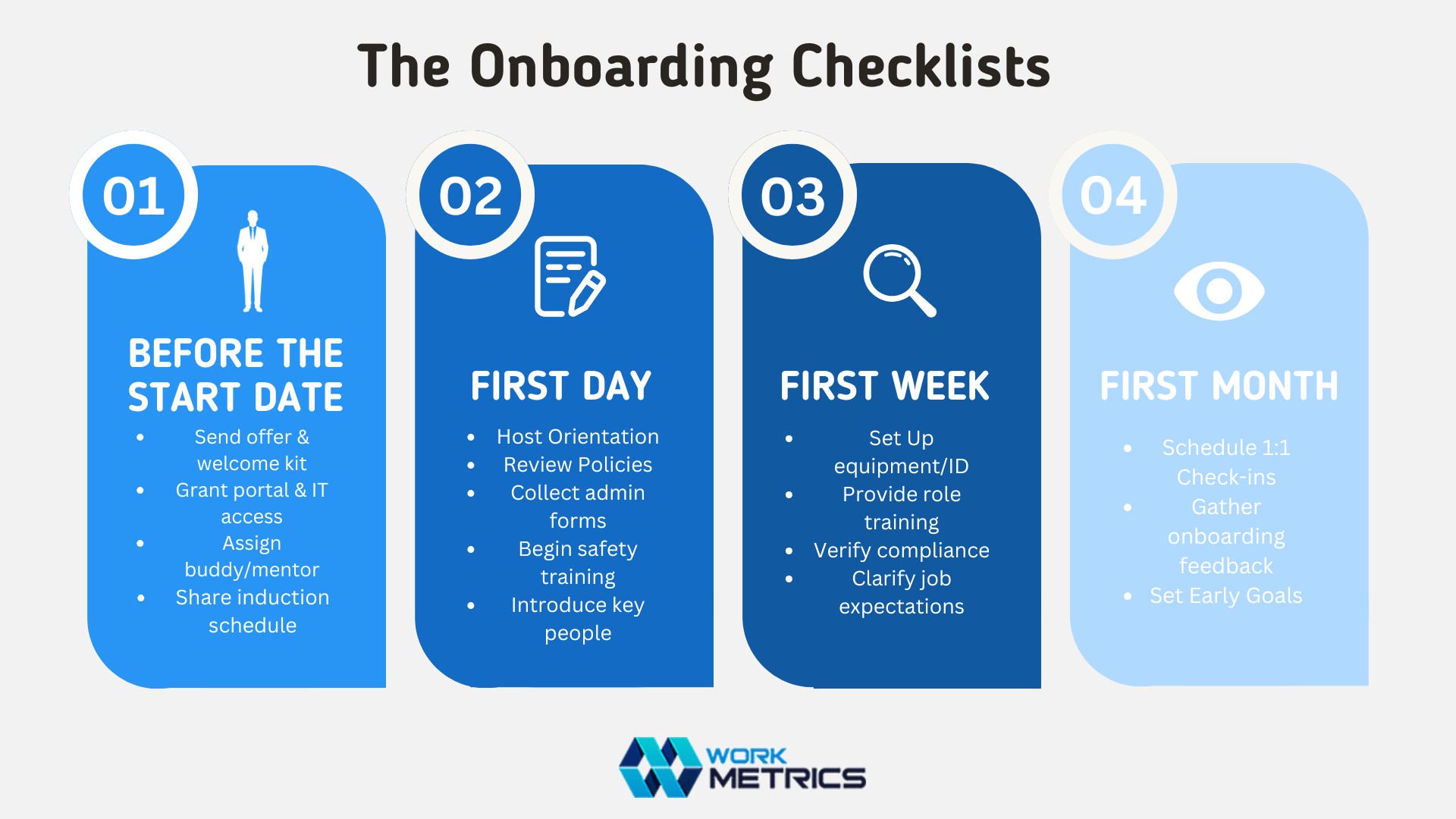
The Onboarding Checklist
A structured checklist helps both the company and new hires stay organized. It ensures no steps are missed and makes the onboarding process smooth and transparent.
Before the Start Date
Send welcome email and offer letter.
Provide access to onboarding portal.
Prepare IT setup (emails, login and software).
Assign a mentor or team buddy.
Share company overview and induction schedule.
First Day
Conduct orientation (in-person or online).
Review policies and procedures.
Collect banking and tax deatils.
Begin safety induction.
Introduce team and management.
First Week
Set up equipment, uniforms and ID passes.
Deliver role-specific training modules.
Confirm completion of compliance requirements.
Review job expectations with manager.
First Month
Schedule one-on-one check-in meetings.
Gather feedback on onboarding experience.
Set early performance or development goals.
Benefits of a Digital Onborading Portal
Platforms like OnlineOnboarding.com make it simple to manage onboarding from start to finish. With automation, templates and tracking tools, you can:
1. Reduce paperwork and manual data entry.
2. Ensure compliance with legal and safety standards.
3. Monitor progress in real time across all staff.
4. Standardize the onboarding experience across multiple sites or departments.
5. Provide a professional, consistent welcome for every new team member.
Online onboarding isn't just convenient- it's a smarter, faster and more reliable way to bring people into your organization. Whether you're onboarding employees, contractors or visitors, everything can be managed from one secure platform.
Get started
Ready to simplify your onboarding process?
Create your OnlineOnboarding.com Portal today to explore real examples, pre-built templates and easy-to-use forms that help you start welcoming new hires the smart way.
 Before the Start Date